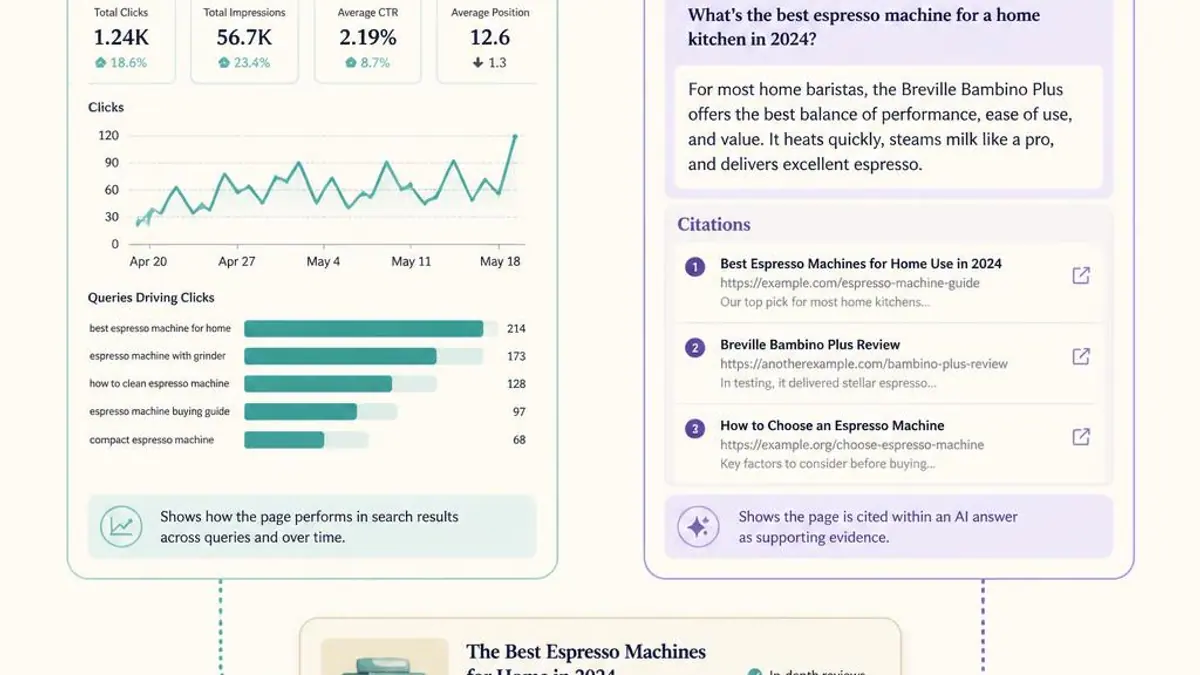
Search Console reports observations from Google Search. AI visibility checks record sampled answers and sources from selected engines. Use both, but do not merge them into a single metric or infer AI impressions from ordinary search impressions.
Identify what each dataset actually contains
For Search Console, note the property, date range, query filters, page filters and available dimensions. For an AI sample, note the question cohort, engine, timestamp, location or language settings and returned citations.
A query string in Search Console and a natural-language prompt may relate to the same topic without representing the same audience or event. Keep their labels explicit in charts and reports.
Use shared URLs as a review bridge
Choose a page that appears in both workflows and inspect what it answers. Search Console may reveal relevant queries that need a clearer explanation; an AI answer may cite a specific paragraph or an alternative source. These observations can guide an editorial task without being mathematically interchangeable.
Do not label a Search Console click as an AI referral unless the evidence actually identifies that channel. Review Google's current documentation for the way its AI features are included in reporting.
Choose a practical review cadence
Allow enough data to accumulate before making strong claims. Keep release annotations and compare equivalent periods where useful, accounting for known changes and sparse data. A new small site may have very limited observations.
Use a final report that distinguishes work done, organic search signals, sampled source signals and unresolved uncertainty. This keeps a useful workflow from becoming an unsupported claim of universal visibility.
Understand what Search Console data represents
Search Console reports performance for Google Search and related documented search features under the selected property and reporting view. Record the chosen date range, query and page filters, country, device and dimensions. Some reporting views omit or aggregate data, so read their documented scope before treating a table as a complete log.
An impression, click or average position does not reveal what every user saw or why a result changed. Keep property ownership, data freshness and filters visible. Use available URL inspection for technical context without assuming it exposes every internal indexing decision.
Treat an AI answer sample as a separate observation
For a checked AI response, retain the exact question, date, engine or feature, locale, language and available source links. Label a mention, citation and recommendation separately. A manually collected answer is an observation of that request and context, not an audience-representative analytics report.
If you cannot collect an answer reliably, log a failed or missing check. Do not infer that a response never occurred from the absence of a record. Establish any lawful data retention and privacy practices before storing full answer text.
Use each source for a question it can answer
Search Console can help assess the site's measured Google Search performance under its reporting definitions. An answer sample can help a team review what a particular response said and which sources it linked. Neither one can stand in for the other or, on its own, establish sales impact.
Analytics can provide a separate view of traffic attributed under its own configuration. Keep campaign tags, referral classifications, consent behavior and model limits in mind. Do not label traffic as AI-originated unless the collection evidence actually supports that source.
Join evidence through page-level editorial decisions
A shared URL can help the team review both sources: compare the questions that bring organic impressions with the tasks sampled in AI answers, then inspect whether the page addresses those readers. This is an editorial bridge, not a formula that combines impressions and citations into one ranking.
Keep reports clearly labeled, include dates and preserve the individual sources behind a summary. If a Google AI report or another dedicated view is announced, check whether it has actually rolled out for the property and follow the current interface documentation rather than assuming universal availability.
Create a source dictionary for the reporting team
For each field, record its system, definition, period, dimensions and known limits. Explain what an organic impression, click, answer check, source link and analytics session mean under the actual collection method. A shared dictionary prevents teams from relabeling one metric as another during a presentation.
Keep changes to source definitions visible. If a provider adds a reporting view or alters aggregation, note the date and assess whether comparisons remain valid. Do not preserve a smooth-looking chart by hiding that its measurement changed.
An illustrative page-level evidence review
A guide might receive organic impressions for procedural questions while a saved AI answer cites it only for a definition. Reviewing the page could reveal that the procedure is hard to find or that the prompt asks a different question. Those are useful hypotheses to investigate, not proof that the two systems disagree about the same event.
Use the shared URL to inspect content and reader intent. Keep each source's observations intact rather than trying to calculate a universal rank from impressions and citations. A page-level editorial action should name the specific missing or unclear information and the evidence needed to correct it.
Report traffic and commercial outcomes independently
If analytics identifies a referral source, preserve the actual classification and any relevant limitations from consent, browser behavior or attribution configuration. A missing referrer does not establish an AI source, and a session does not automatically establish a qualified lead or sale.
Use separate evidence for commercial outcomes and avoid presenting correlation as causation. A combined report can still be useful when it clearly groups search performance, answer observations and business results, with the period and collection method attached to each.
Source-boundary review checklist
Before combining evidence in a presentation, verify the origin and definition of each field. Keep raw observations accessible to authorized reviewers and avoid relabeling one source to fill a gap in another.
- Search Console metrics retain their property, reporting view, date range, filters and documented scope.
- AI observations retain exact prompts, engine, language, location, timestamp and response availability.
- Mention, citation and recommendation labels correspond to evidence in the actual saved answer.
- Analytics attribution is described under its real configuration and never guessed from a missing referrer.
- A shared URL supports editorial comparison without making unlike impressions, answers and sessions mathematically interchangeable.
- Business outcomes have their own evidence, and correlation is not described as a proven effect of an article update.
- New reporting features are confirmed in the actual property before being promised to every account.
Apply this workflow in RankZoro
Start with measurement and reporting and review the relevant RankZoro capability. Use the output to organize evidence and editorial work, not as a guarantee of search inclusion. Compare plans before running paid or credit-based actions.
Continue with How Agencies Can Report AI Visibility Without Overclaiming Results or How to Compare AI Visibility Before and After Publishing Changes. These are supporting explanations, not independent proof of measured outcomes.
Sources and methodology
- Google: AI features and your website — Eligibility, search fundamentals, and reporting limitations.
- Google: creating helpful, reliable content — People-first content and evidence of experience.
- Google: spam policies — Doorway pages and scaled content abuse are not an expansion strategy.
Prepared by the RankZoro editorial team. Examples are illustrative unless explicitly identified as observed data. No customer outcomes or search-volume estimates are claimed.