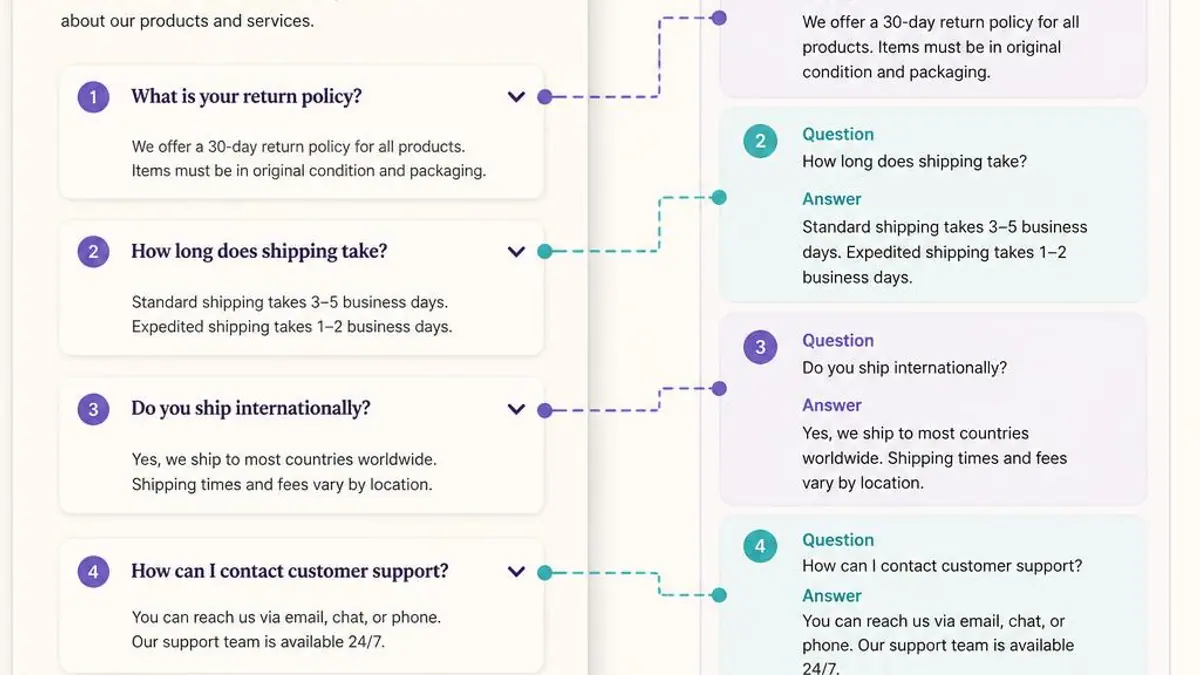
FAQ structured data should describe the questions and answers readers can actually access on the same page. Use accurate JSON-LD, avoid promotional invented answers and validate both the markup and the visible experience.
Start with the reader-facing FAQ
Choose genuine unresolved questions about the article's method or limitations. Write concise answers that do not introduce unsupported promises. The FAQ should still be useful if every structured-data script is removed.
An expandable answer can be part of the accessible page, but do not mark up hidden promotional claims that readers cannot find. Keep links and qualifications in the visible answer rather than putting a simplified promise only in metadata.
Keep the representations aligned
Use the same question and answer records for rendering and JSON-LD whenever possible. Escape JSON safely and validate that the script parses. If an editor changes an answer, regenerate the corresponding markup rather than maintaining a separate stale copy.
Review whether FAQPage is the appropriate type for the page. A community question with multiple user answers has different semantics from an editorial FAQ supplied by one publisher.
Do not sell markup as an outcome
Google's current FAQ guidance restricts rich-result availability, including to well-known authoritative government or health sites. A valid FAQ block on a software blog should not be marketed as guaranteed FAQ search visibility.
Use validation to catch syntax and policy mismatches. Then measure the outcomes separately: page access, search observations and sampled AI citations. Markup is a description of the content, not an instruction forcing a search system to display it.
Confirm that FAQ content belongs on the page
The questions should represent actual information a reader needs about the page's subject. Write the answer so it can be understood outside the exact article context, then include any critical condition or exception. If the question is about another product, service or unsupported capability, move it to the appropriate owner or remove it.
Avoid manufacturing business facts, testimonials or official endorsements in FAQ copy. A concise answer can be useful without claiming that every individual situation follows the same outcome. Give regulated or high-impact claims a qualified reviewer.
Keep visible answers and structured data consistent
Each marked-up question and answer should match the content a visitor can read on the page. Check the page after publishing and compare the rendered FAQ with the JSON-LD output. If the CMS uses a reusable FAQ field, confirm that changes in one source update both representations.
Do not hide text from people while exposing it only to a crawler. Remove markup for content that has been deleted or changed. A schema validation pass can catch syntax problems, but a human must still confirm that the content is accurate and appropriate.
Choose the schema type and properties carefully
Use a vocabulary and schema type that actually describe the page and follow current search-engine policies. Do not apply an FAQ object to an article that contains no visible FAQ, or add unsupported author, rating or review data because a generator offers an optional field.
Structured data helps machines interpret described content; it does not create a guarantee of a rich result, special ranking or AI citation. Confirm current eligibility directly from the search engine's documentation before promising any display outcome.
Validate after template and content changes
Test a representative public URL after updating a template, then spot-check a few pages with different numbers of FAQ entries. Confirm valid JSON, stable URLs, escaped punctuation and no duplicated question IDs. Ensure a page without FAQs does not inherit stale markup from a shared template.
When an answer changes, update the visible text, structured data and relevant last-modified information together. Keep a record of the change and revisit any connected localization. A successful validator indicates syntax and policy checks it performs; it is not proof that a search engine will display the markup.
Use one editorial source for each question and answer
Where a CMS supports it, keep the visible FAQ and structured data derived from the same approved fields. If an editor must update two separate copies, include an explicit comparison in the release checklist. Otherwise the page can quietly show one answer while describing another to a parser.
Preserve the exact meaning when converting markdown or HTML to schema text. Remove formatting syntax without deleting important qualifications. A short answer that loses an exception during conversion can become inaccurate even though its JSON is valid.
An illustrative schema consistency check
Suppose the visible FAQ says an export requires a saved article, but the schema answer says every live draft can be downloaded. The task is not to choose the more promotional answer. Confirm the actual product behavior, correct the approved source and regenerate both representations consistently.
This is a hypothetical product example. Use it as a review pattern for pricing, availability and limitations as well: validation of syntax does not verify facts. A qualified reviewer must approve statements about the business, and the final public page must show the approved answer.
Maintain FAQ quality after localization and redesigns
After translating a page, check the localized visible FAQ and its structured representation together. Ensure conditions, units, product names and links retain the intended meaning. Do not automatically reuse an English answer in another language's markup when visitors see a different or incomplete statement.
After a redesign, test that collapsible answers remain accessible and that removed FAQ sections do not leave orphaned schema. Keep the publication and modification metadata truthful. Rich-result eligibility and display are separate external decisions, even after the page passes these checks.
FAQ release checklist
Validate content and syntax separately. A machine can report valid JSON while the answer remains wrong, unsupported or inconsistent with the visible page.
- Every question is relevant to the page and each answer has an approved factual basis.
- Visible questions and answers agree in meaning with their structured data, including qualifications and exclusions.
- Markup uses an appropriate type and does not invent ratings, authorship, reviews or endorsements.
- Deleted or translated FAQs do not leave stale answers in a shared template.
- The public page, not only the CMS preview, has been checked after the change.
- Rich-result eligibility and external display remain distinct from the site's successful validation.
Apply this workflow in RankZoro
Start with crawling, schema and indexing and review the relevant RankZoro capability. Use the output to organize evidence and editorial work, not as a guarantee of search inclusion. Compare plans before running paid or credit-based actions.
Continue with IndexNow vs Google Indexing: What Each Can and Cannot Do or How to Check Whether Search Crawlers Can Read Your Page. These are supporting explanations, not independent proof of measured outcomes.
Sources and methodology
- Google: AI features and your website — Eligibility, search fundamentals, and reporting limitations.
- Google: creating helpful, reliable content — People-first content and evidence of experience.
- Google: spam policies — Doorway pages and scaled content abuse are not an expansion strategy.
- IndexNow documentation — A submission receipt is not confirmation of indexing.
- Google: structured data policies — Markup must match visible content and does not guarantee a rich result.
- OpenAI: crawler controls — Search crawling and model-training controls are independent.
- Google: generative AI performance reports — June 2026 announcement of a subset rollout; check actual property availability, not assumed access.
- Google: crawlable links — Descriptive anchors and relevant internal discovery paths.
Prepared by the RankZoro editorial team. Examples are illustrative unless explicitly identified as observed data. No customer outcomes or search-volume estimates are claimed.